

Conversion rate optimisation (CRO) improves the percentage of visitors who take a desired action, such as submitting a form or completing a checkout. A clear CRO strategy turns existing traffic into more leads and sales without relying only on higher ad spend. It also reduces waste by testing what works, using methods such as A/B testing, heatmaps, and funnel analysis. With structured measurement and iteration, CRO helps teams make decisions based on evidence, not assumptions.
Key takeaways
- CRO increases conversions through structured research, analytics, and controlled A/B testing.
- Improving conversion rate raises revenue per visitor and lowers customer acquisition cost.
- Prioritise high-intent pages like landing, pricing, checkout, and enquiry forms.
- Build hypotheses from analytics, heatmaps, and user feedback before testing changes.
- Sustain gains with disciplined measurement, guardrails, and documented test learnings.
What Conversion Rate Optimisation (CRO) Means and How It Works
Conversion rate optimisation (CRO) is the structured process of increasing the share of website visitors who complete a defined goal, such as a purchase, enquiry, or sign-up. CRO focuses on measurable behaviour, not design preference, and it treats every change as a testable hypothesis. A conversion rate is calculated by dividing conversions by total visits and multiplying by 100, which makes progress easy to track across pages and campaigns.
CRO works by combining analytics, user research, and controlled testing to isolate what drives action. Teams start by measuring key events in analytics tools such as Google Analytics, then identify friction points using session replay and heatmaps from platforms like Hotjar. Next, they run A/B tests, where two versions of a page compete under the same traffic conditions, using tools such as VWO. This approach reduces guesswork because it links each change to a measurable outcome.
In practice, CRO improves revenue efficiency because it increases results from existing traffic, which can lower the cost per lead or sale. It also improves decision-making by creating a repeatable cycle: measure, test, learn, and apply the learning across similar pages. Over time, CRO builds a clearer view of what customers need to move from interest to action.
The Business Impact of CRO: Revenue, Customer Acquisition Cost, and Marketing Efficiency
CRO changes the economics of growth. Option A relies on buying more traffic to lift revenue. Option B improves the percentage of existing visitors who convert, so revenue rises without the same increase in spend.
| Metric | Option A: More traffic | Option B: CRO-led growth |
|---|---|---|
| Revenue impact | Scales with budget and reach; returns can fall as audiences saturate. | Scales with conversion improvements; lifts revenue per visit. |
| Customer acquisition cost (CAC) | Often rises as bids increase and targeting broadens. | Can fall because more conversions come from the same sessions. |
| Marketing efficiency | Optimises spend allocation, but waste persists if the site underperforms. | Reduces leakage across landing pages, forms, and checkout steps. |
| Measurement | Focuses on channel metrics (CPC, CPM, CTR). | Focuses on on-site outcomes (conversion rate, revenue per visitor, drop-off). |
The practical implication is budget resilience. When paid media costs rise, CRO protects margins by improving revenue per click and reducing the number of clicks needed per sale.
For governance, link CRO targets to commercial metrics: track conversion rate alongside revenue per visitor and CAC, and validate changes using controlled A/B tests (for example, via Google Optimize documentation for testing concepts, even though the product has been sunset).
Where CRO Delivers the Biggest Gains: Key Pages, Funnels, and User Journeys to Prioritise
CRO delivers the biggest gains when it targets pages and journeys that control high-intent decisions. These areas sit closest to conversion events, so small reductions in friction can lift completed actions without changing traffic volume. Prioritisation starts with identifying where users enter, where they drop out, and which steps influence revenue or lead quality.
High-impact targets usually include landing pages from paid and organic search, product or service detail pages, pricing pages, checkout or enquiry forms, and account creation flows. These pages often concentrate key behaviours such as adding to basket, starting checkout, submitting a form, or confirming payment. CRO also performs well on micro-conversions that predict later outcomes, such as email sign-ups or brochure downloads, when those actions correlate with qualified leads.
The process works by mapping each funnel step to a measurable event, then diagnosing constraints using analytics, session recordings, and user feedback. Tools such as Google Analytics help quantify drop-off by step, while A/B testing platforms validate whether a change improves completion rates. Clear prioritisation prevents scattered testing and keeps effort focused on bottlenecks with the strongest commercial impact.
This focus matters because not all pages have equal leverage. Improving a low-traffic blog page rarely moves outcomes, while improving a checkout step or lead form can raise conversions across every acquisition channel that feeds that journey.
How to Build a CRO Strategy: Research, Hypotheses, Testing, and Measurement
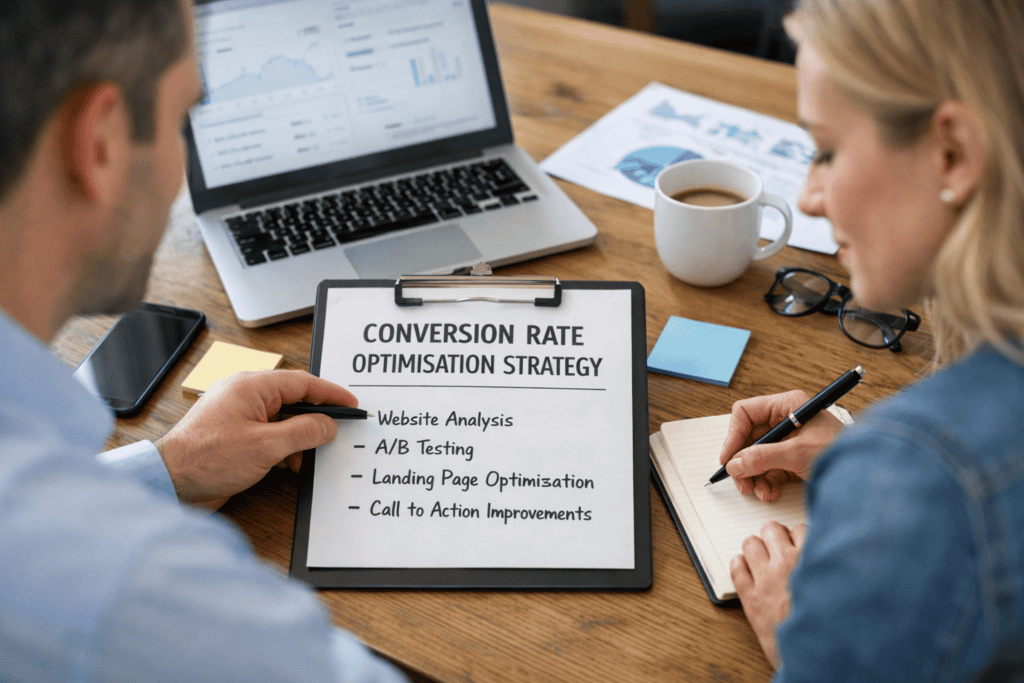
Build a CRO strategy by setting a single primary conversion goal per journey, then running a repeatable cycle: research, hypothesis, test, and measurement. Keep the scope tight. Focus on one page type or funnel step at a time, and define success before any change ships.
What to do: run structured research
Start with evidence, not opinions. Combine quantitative data (what happened) with qualitative insight (why it happened). Use Google Analytics or a similar analytics tool to find high-traffic pages with weak conversion rates and steps with high exit rates. Add behavioural tools such as Hotjar to review heatmaps, scroll depth, and session recordings.
- Audit the funnel: entry pages, key steps, and drop-off points.
- Segment by device, channel, and new vs returning visitors.
- Collect direct feedback with short on-page surveys and form error reviews.
How to do it: write hypotheses and test
Turn findings into hypotheses with a clear cause and measurable effect. A useful format is: “If we change X for audience Y, metric Z will improve because of reason R.” Prioritise tests with a simple scoring method (Impact, Confidence, Effort) so the team ships high-value work first.
Run A/B tests using a controlled tool such as VWO or Optimizely. Track a primary metric (for example, completed purchase or qualified lead) and 1–2 guardrail metrics (bounce rate, average order value, refund rate) to avoid “winning” changes that harm quality.
What to watch out for: measurement errors and false wins
Do not stop tests early or chase small uplifts without enough data. Validate tracking before launch, and keep the test stable by limiting other site changes. Watch for seasonality, campaign spikes, and mixed audiences that can distort results. Document every test, outcome, and learning so future iterations compound rather than repeat.
Common CRO Mistakes to Avoid and How to Sustain Results Over Time
Common CRO mistakes come from treating optimisation as a one-off redesign instead of a controlled measurement programme. A frequent error is testing too many changes at once, which makes results hard to attribute and slows learning. Another is choosing weak success metrics, such as clicks, when the business outcome is revenue, qualified leads, or retained users.
Sustained results depend on clean measurement and disciplined governance. Validate tracking in Google Analytics and align event definitions with the primary conversion goal, so tests measure the same outcome over time. Use a consistent testing method, such as A/B testing, and set guardrails for sample size and test duration to reduce false positives.
Long-term gains come from building a backlog of hypotheses tied to user evidence, then re-testing when traffic sources, pricing, or UX patterns change. Document each test, keep winning variants under monitoring, and review performance monthly to catch regression early.
Frequently Asked Questions
What is conversion rate optimisation (CRO), and how does it differ from SEO and paid advertising?
Conversion rate optimisation (CRO) improves the percentage of visitors who complete a goal, such as a purchase or form submission, by testing and refining pages, messaging, and user journeys. SEO increases organic traffic by improving search visibility. Paid advertising buys traffic through platforms like Google Ads. CRO focuses on turning existing traffic into more leads or sales.
Which website and funnel metrics should a CRO strategy track to measure impact?
Track metrics that show both behaviour and outcomes: conversion rate by page and funnel step, revenue per visitor, average order value, and lead-to-customer rate. Monitor drop-off rate between steps, form completion rate, and cart abandonment rate. Add quality checks such as bounce rate, exit rate, and page speed (Core Web Vitals) to spot friction.
How can businesses identify the highest-impact pages and steps to prioritise for CRO testing?
Start with analytics to find pages with high traffic and low conversion rate. Prioritise steps with the biggest drop-offs in the funnel, using funnel reports and event tracking. Check landing pages from paid and SEO channels, plus key forms and checkout steps. Validate with heatmaps, session recordings, and user feedback to confirm friction points.
What types of CRO tests and research methods produce the most reliable conversion insights?
The most reliable CRO insights come from controlled A/B tests and multivariate tests with adequate sample sizes and a pre-set success metric. Pair testing with quantitative research (analytics funnels, heatmaps, form analytics) and qualitative research (on-site surveys, usability testing, session recordings). Triangulating 2–3 methods reduces bias and explains both what changed and why.
How should a business structure a CRO programme to balance quick wins with long-term learning?
Structure a CRO programme in two tracks: a “quick wins” backlog and a research-led testing roadmap. Reserve 20–30% of capacity for low-risk fixes (copy, forms, speed) and 70–80% for hypothesis-driven experiments. Use a single prioritisation model (impact, effort, confidence), run weekly reviews, and document results in a shared learning log.